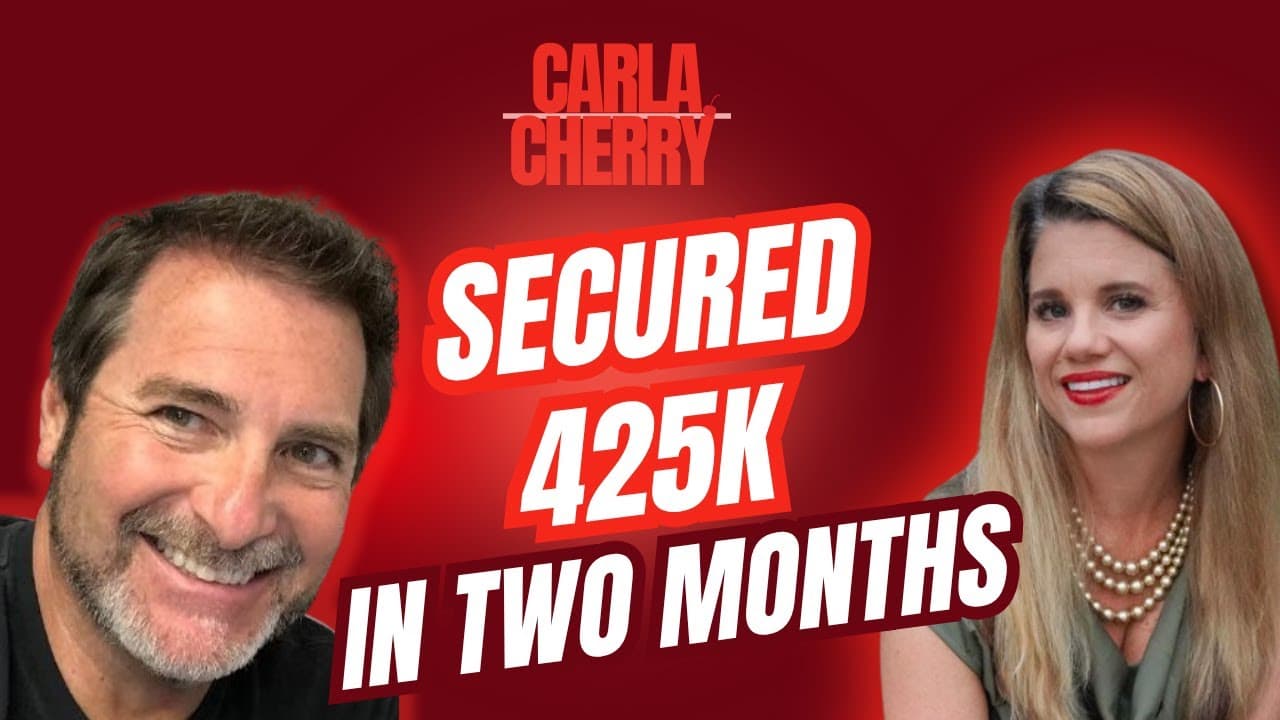
He had referrals. Now he has a process.
Added a sales process for the people he does not know, on top of the referrals he received.
Rick P. is an independent philanthropy consultant who received a lot of referrals. Carla's team helped him with the people he did not know and the cold marketing he was not doing: a process, a system and messaging around them.
He went to Hawaii partly to meet a client he got through that process, and the group decided to work with him within 24 hours. Another client, based in New York City, locked arms with him.
Carla also asks him the questions her prospects ask most: start now or later, can I do it without help, is the cost worth it.
The interview
Carla Cherry with Rick P.
Hello. I'm Carla Cherry, a Power Offer consultant, sitting here with Rick P. He's a philanthropy guy, an independent philanthropy consultant who's helped raise hundreds of millions of dollars over the years. He has gone through our program and is in our ongoing program, and I'm so excited to speak with you today about that. Hey, Rick, how are you doing?
I'm great. Thanks for having me, Carla.
Thanks for joining. All right, I'm going to ask you straight out of the gate: what was your biggest win working with us?
I think your team helped teach me about process as it relates to sales. In the past, I'd received a lot of referrals, but you and Samir helped me understand the idea of "What about all the people you don't know? What about all the cold marketing that you're not doing? How do you develop a process and a system and messaging around that?" That's really what I've learned in great detail from you and your team.
Perfect. I thought we would do a fun exercise, because we get the same questions over and over again. I thought it might be really interesting to ask you these questions as someone who's gone through our process and is still in our ongoing program, so that you can speak directly to people who are considering our program and have these questions. Are you ready?
Ready to go.
All right, let's go. The number 1 thing people ask is: should I start now or should I start later? Should I get a couple of clients under my belt and then start? Should I try it on my own? It's a timing question. How would you answer that?
I'd say, why wouldn't you want to start out on the right foot? Why would you want to start doing things that might actually be bad habits in prospecting or closing new clients? Why wouldn't you want to do things in a more systematic, streamlined way from the outset, so you develop good habits? That's what I would say.
You and I were talking about this before we hit record. A lot of people have 1 or 2 hot leads that they close straight out of the gate. It's very common. They close 1 or 2, and they think, "Oh, this is easy," because they had a really good reputation. They've amassed a lot of experience.
I typically tell people that the first 1 or 2 are pretty easy to close. Sometimes they get into a situation where they think, "Oh, man. I'm working way too hard." They didn't set up the parameters correctly, so it really feels like being a glorified employee, which is its own problem. But those first 1 to 2 are pretty hot. The rest are warm leads.
I define a warm lead as anyone from someone you've worked with before all the way down to a neighbor, a spouse's friend or a parent of your kid's friend.
With that variety of warm leads, most people don't know how to close them. They just don't. They don't have a process. They've never tried it. They think they're just going to go have a coffee with somebody. What happens is they sometimes get their feelings hurt: "What if people don't like me?" Or they might even get to a proposal in the inbox, and then they're just sitting there, crickets, waiting.
So how would you describe going from that experience to having a process, learning from us how to close warm leads? We close warm leads, and we also close cold leads, but let's just talk about the warm first.
Even a warm lead needs to be closed, in the sense that they're coming to buy, but they're still making a buying decision. Even if they know you and they like you, they still want to know that they can trust you, that you'd be a good steward or a good person to work with, and that your company will treat them right. So I think they still need to be closed on what I would call the basics of sales, because they want to know that you're a professional. They don't want to feel like you're desperate for their business either.
That's the irony of it all. They should feel, "I'm working with you, but you're not solely focused on me being your only client." Otherwise it's, "I feel the pressure of just trying to be a good person and help you out." Even worse, now they're working with you because they feel bad for you.
But I think going back to the structure of the sales call and closing them appropriately is good. Maybe you won't have to work as hard because they know you, but I think you still need to have the fundamentals in place to do that.
They're missing the frameworks. That's what I tell everybody. It's a new skill. Most people coming out of corporate have never had to close. They're missing that skill and those frameworks. Once they plug into the soft sell close that we teach in phase 2, I tell people they're not only going to garner the intel, they're going to get out of the vagueness of "Am I selling the right thing? What am I selling? How do I sell?"
We're going to get you out of that vagueness, and it's a soft sell methodology. On average, our clients are closing at least 1 to 2 in phase 2 with our warm close frameworks. Can you speak to that? Once we taught you that process, how did you feel versus trying to close those people on your own?
Well, I think it just gives people the comfort of knowing that they're working with a professional. You've set them up, or we set them up, so that they feel confident coming into the conversation. Then it's just a matter of following a lot of those tie downs and things like that. You're getting people to say, "Yes, I do need this," and "Yes, you have brought up an interesting point." You're helping them almost close it for themselves.
You're saying, "I'm a competent subject matter expert. The question is, do you want my help? Are you ready to work with me?" Not "Am I good enough for you?" but more like "Are you ready to make this decision?"
Exactly. Let's go on to the next question. People oftentimes want to know, "Can I do it without Carla? Do I need help?"
It goes back to the classic: even professional athletes have a coach.
That's right.
So you probably could do it. The question is, are you doing it as efficiently as you should be? Are you going to look back a year from now and say, "I probably could have been doing things a little differently if I had just known a different path, but I chose to ignore that path and I went down this other path. I could be maybe closing twice as much business and have a lot less stress in my life if I were following more of a proven pathway"?
That's right. We have a lot of people who come to us and say, "Oh, I'm only going to charge $5,000, because I need to get a couple of clients, and then I'm going to charge more." Laura just closed a $350K deal, and that was her first time out. She had never sold anything before.
That's what we set you up for. We play big. Okay, so is the cost worth it?
Absolutely. It's an investment in the way you do things as a practitioner, and then you just keep on building on that. So whatever you're spending, you're going to get that back and then some, because it's going to just keep on building on itself.
People who try it on their own, I usually say, are going to pay with time. And the problem with people leaving corporate is that a lot of times they don't have that much time. They have a short runway. They're tapping into savings. I know it is scary to invest with somebody that you've just met. However, I think it's worse to risk having to go back to corporate if you really don't want to, if that's soul killing.
And you need to spend money to make money. It's the old adage: you invest in the people who know what they're doing and have done this before. The way I look at it, Carla, is that you and your team have a vested interest in your own clients' success. You do not want to have people pay you money and then walk them through a process that doesn't work. You want everyone to be successful. You both have skin in the game.
Well, the thing about online businesses is that if it didn't work, we wouldn't have a business. That's it.
People always say, "Well, what if you're going to leave me?" Someone said today, "What if you win the lottery or you get hit by a bus?" I said, "Listen, we are a team of 10, and we lock arms with you. We're in the trenches. We're not going anywhere."
We actually have to worry about our clients getting scared or trying to push pause because they didn't do their homework. You don't worry about us. On our side, we're there. Okay, so people ask you: what is the process?
Well, the process is, first of all, what's your message? And of course: do you have some testimonials? Do you have people who can speak on your behalf about what you've done?
Success stories are one thing I've definitely learned from you. You have to be able to tell what those success stories look like.
The return on investment, the fact that you can do it with a certain speed and efficiency, is important. But it's also socializing the potential client, saying, "It's going to be okay. I'm a competent person. Let me show you the successes that I've had. This is the process that I go through." It's funny, because I feel like your process is to help us refine our process.
That's right.
It's to determine how to do this not only once in a very effective way, but again and again in a scalable way.
That's right. I just want to share really quickly: you just got back from Hawaii, and you have been getting clients. People always say to me, "Well, what if it doesn't work? Can I quit if it doesn't work?" Can you share a little bit about Hawaii, and what you would say to that?
Well, I don't even think you know this, Carla, but one of the reasons I went to Hawaii was because I met with a client who I got through your process.
That's amazing.
I met with them and we did an all day session together, and I am absolutely certain we're going to do a lot of business together. They have quite ambitious goals, and we hit it off. We were able to work together within 24 hours. That's how quickly this particular group made a decision.
They were looking to partner with somebody like me. The process worked. We did step 1, and now we're going to go on to do lots of other things. Not surprisingly, this nonprofit is connected to other nonprofits in the area. This nonprofit wants to raise money, and of course they're going to want to help other nonprofits that they work with raise money.
That's a good example of how you just never know where the positive influence is going to stop. Oh, we're just getting started.
And you met him online. You met him through our process.
I wouldn't have been able to do it without the process.
Absolutely.
And then there's another one, another gentleman, and he is New York City based, and he locked arms with me.
We're going in, and we're doing incredible things together. They have a hundred and fifty million dollar goal, and we're setting the parameters and the stage to do that. We're already in a conversation right now with a donor, and he's using my coaching very heavily. It could be a twenty-five million dollar gift for this particular nonprofit. We're firing on all cylinders here.
I'm so excited for you, and I can't wait to talk to you more about that. Thank you so much for sharing with me today. I'm going to play this video and let people who have these questions hear from a client of ours. I really appreciate it. So thanks, Rick.
Thanks for all you do, Carla. I really appreciate it.
You got it.
Ready to sell your expertise to corporate?
Bring your current revenue, your six-month vision, and what you think your bottlenecks are.
Book a free 30-minute call